

India lifted an estimated 496 million people out of extreme poverty between 2011 and 2023, with the share of the population living below the $3.00-a-day line falling from 27.1% to 2.6%, according to the World Bank’s October 2026 Poverty and Equity Brief.
The bank called the decline “one of the fastest poverty reductions in the world” and attributed it mainly to strong consumption growth, rising employment, especially among women, and expanded social transfers including food subsidies.
The same report (PDF), however, shows that the headline number hides a more complicated picture.
The share of Indians below the lower-middle-income line of $4.20 a day (2021 PPP) fell from 57.7% to 16.1% over the same period, but roughly 342 million people still live below that threshold.
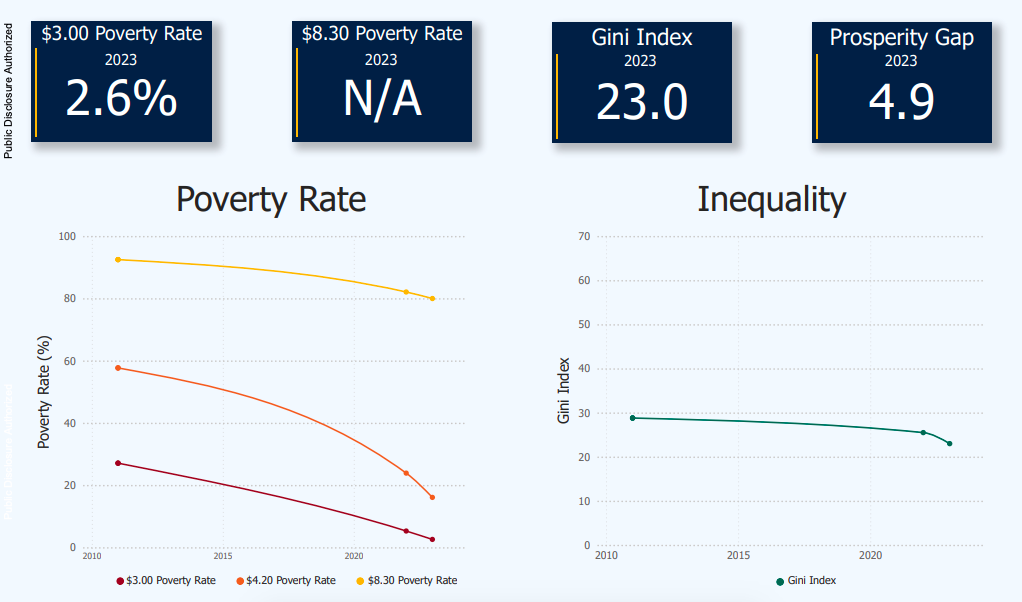
The bank projects the $4.20-a-day rate will fall further, from 14.2% in 2026 to 12.1% by 2028, though it cautions that these are indicative microsimulation estimates subject to revision.
Geographically, poverty has become more concentrated even as it has shrunk.
A contiguous belt of states stretching from Uttar Pradesh to West Bengal accounts for about 57% of India’s poor population, the brief says, making productive employment in those states the decisive factor for further reductions.
Rural poverty remains higher than urban poverty, and the bank notes that many of the remaining poor have lower education, fewer assets, and limited access to stable work.
The employment story is similarly mixed. Between 2017 and 2023, employment grew by about 134 million people, nearly twice the growth of the working-age population, driven largely by rural women entering paid work.
Yet real earnings remained broadly unchanged, and much of the new employment is concentrated in low-productivity activities.
Youth unemployment rose from 14.6% to 15.9% between the first quarters of FY26 and FY27, with rural young women particularly affected.
However, the era of rapid, broad-based poverty reduction is giving way to a harder phase in India. The remaining poverty is no longer spread evenly across the country. It is clustered in specific states, among households with fewer assets and less education, and in jobs that do not reliably raise real incomes.
The World Bank’s numbers suggest that further progress will depend less on repeating the consumption and welfare gains of the past decade than on raising productivity and earnings in the belt from Uttar Pradesh to West Bengal.
