Two papers published in Nature on 18 November 2026 report nine hominin teeth from two caves in Guangxi Zhuang Autonomous Region in southern China, eight of them identified as Homo erectus, and date the material to a period when the species was thought to have vanished from mainland Asia. The work pairs a taxonomic study of the teeth with a dating and environmental study of the same deposits.
Baxian and Naxian sit about 15 km apart in karst terrain near Chongzuo, on the west bank of the Zuojiang River. Baxian lies 20 km north of Chongzuo and Naxian lies 13 km northwest of the city.
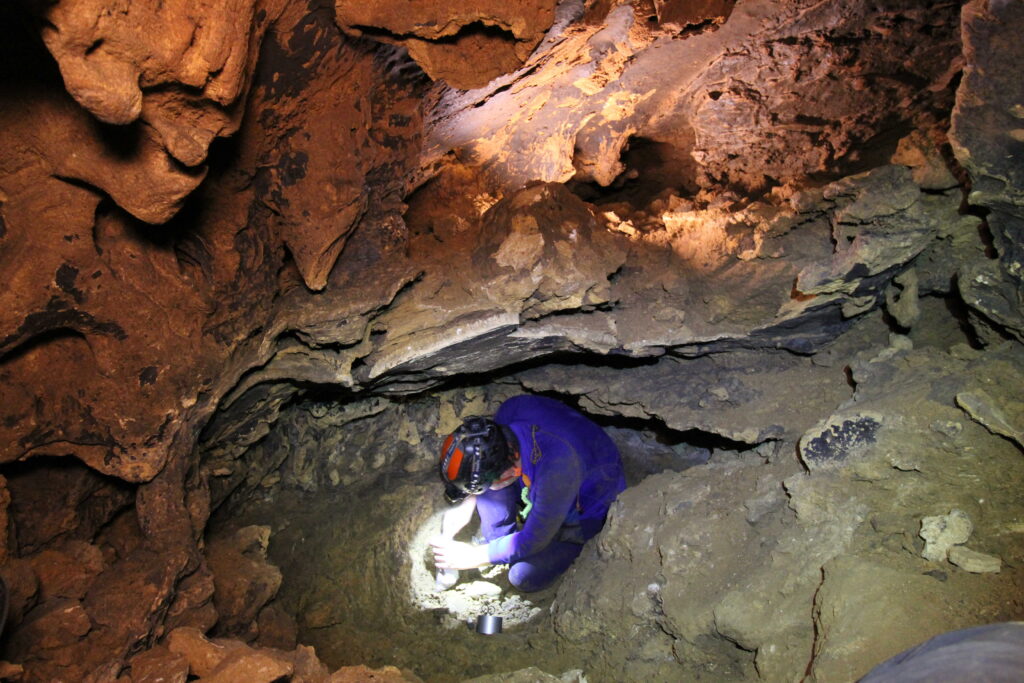
Each cave has a small fossil chamber at the rear, filled with dense cemented breccia capped by thick flowstone and underlain by younger mixed sediments.
Together the breccias yielded more than 18,000 mammalian fossils, including Elephas, Pongo and Stegodon, plus elephants, apes, pandas, tapirs and rhinos.
The team found the caves while looking for fossils of Gigantopithecus, a three-metre-tall great ape.
Local knowledge pointed the researchers to the breccia in the rear chambers. The bone had set so hard that jackhammers were needed to break blocks of breccia, and fossils were then extracted with geological hammers.
The authors write that porcupines had first accumulated much of the bone, dragging it to the back of the caves to gnaw.
How the teeth were named
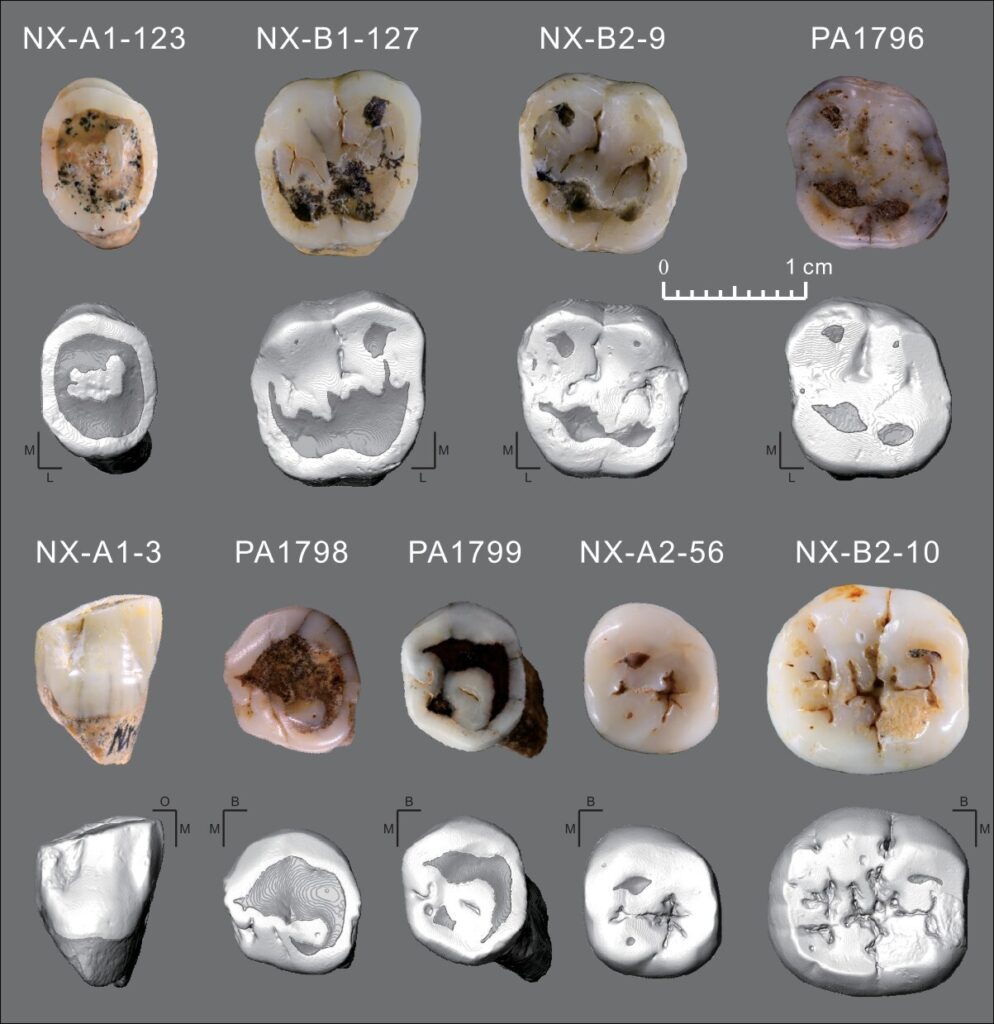
The nine teeth cover different positions. From Naxian came a fourth upper premolar, two first upper molars, a first lower canine, a fourth upper premolar and a second upper molar. From Baxian came a second upper molar, a third upper premolar and a fourth upper premolar. Eight show a combination of features found in Homo erectus, including an asymmetric premolar crown, short upper molar crowns with a square to slightly rhomboidal outline, and a distinctive dendrite-like enamel-dentine junction seen in micro-computed tomography scans.
Protein work on five teeth strengthened the identification. Four teeth carry a derived amino acid substitution at position 253 of ameloblastin, AMBN A253G, previously seen in six Homo erectus teeth from East Asia dated to about 400,000 years ago. The same four form a clade with those earlier specimens but sit apart from them, which the authors read as a previously unsampled Homo erectus population. Protein traces also gave a genetic sex for five teeth, four males and one female, and ruled out an orangutan attribution.
“This is a fascinating discovery because it confirms the presence of Homo erectus in a location we were not expecting and at a time we hadn’t considered,” said Kira Westaway, a professor at Macquarie University in Sydney and a co-lead author of the research. “This has huge implications for the timeline of Homo erectus as we attempt to understand the causes of its extinction.”
How the age was fixed
The team used five dating techniques on sediments, teeth and mineral formations: post-infrared infrared-stimulated luminescence dating of feldspars, optically stimulated luminescence dating of quartz, uranium-series dating of teeth, coupled uranium-series electron spin resonance dating of teeth, and uranium-series dating of carbonate capping flowstones. Results were combined in two Bayesian age models, ChronoModel and OxCal.
Of 45 radiometric ages from both caves, 43 were modelled. ChronoModel gave 324,000 to 184,000 years ago for Baxian and 319,000 to 241,000 years ago for Naxian. OxCal gave 312,000 to 161,000 years ago.
The authors used the ChronoModel result for its greater outlier tolerance and more reliable lower age limit. The age uncertainties for the two caves overlap over about 78,000 years, which the papers treat as contemporaneous or near-contemporaneous presence on the same valley floor.
A forest diet
Faunal teeth at both sites point to forest, not grassland. Plant-equivalent carbon values for Baxian fauna ranged from minus 31.5 to minus 23.0 per mille, with an average of minus 27.6. Naxian fauna ranged from minus 34.0 to minus 25.1 per mille, with an average of minus 29.4. Both sets fall below the dense-canopy forest threshold of minus 27.5 per mille, with no evidence of C4 plant consumption. Oxygen and clumped isotope work also points to humid tropical conditions with higher precipitation and cooler temperatures than in the region today.
Three Homo erectus teeth from Naxian gave carbon values from minus 15.0 to minus 14.0 per mille, at the boundary between dense-canopy forest and more open C3 vegetation. The authors write that the values are consistent with the much larger faunal assemblage and with consumers getting dietary carbon from closed-canopy C3 vegetation. The Naxian sample is small, with three teeth, and is restricted to one cave.
“Teeth can record the environments in which animals and humans lived,” said Nicolas Bourgon, of the Max Planck Institute of Geoanthropology. “In this case, the animal teeth and the Homo erectus teeth are telling the same story: these individuals were part of a rainforest ecosystem.”
“While there has been growing recognition that our own species, Homo sapiens, adapted to rainforests around the world between 100,000 and 13,000 years ago, this is the first clear, direct evidence we have for another hominin living within these habitats,” said Patrick Roberts, a professor at the Max Planck Institute of Geoanthropology.
“These findings change how we think about Homo erectus,” said Yingqi Zhang, of the Institute of Vertebrate Palaeontology and Palaeoanthropology of the Chinese Academy of Sciences. “Finding evidence of Homo erectus for the first time among a rainforest fauna challenges all our assumptions about their ability to adapt to environmental changes.”
Travel in childhood
Strontium in tooth enamel reflects the geology where food and water were taken in while teeth formed, between about ages two and six. One Baxian individual, PA1799, gave strontium ratios from 0.7110 to 0.7220. Three Naxian teeth gave overlapping but distinct ranges. All four individuals show movement between geologically distinct areas or use of resources from multiple places during childhood.
The local Baxian to Naxian area is relatively uniform, with values of 0.710 to 0.715, reflecting Carboniferous to Permian limestone karst. More radiogenic values of 0.717 to 0.723 occur to the west and northwest in mountainous areas, while intermediate to more radiogenic values of 0.715 to 0.720 mark areas to the south, including the Red River valley of northern Vietnam. Geographic assignment maps for three representative values in the human teeth point toward movement from local karst to more distant areas, with the most radiogenic traces pointing as far as northern Vietnam. The papers put the possible range at about 250 km.
Renaud Joannes-Boyau, a professor at Southern Cross University in Lismore and a co-lead author, said some of the chemical traces in the fossil teeth point well beyond the immediate cave region, potentially toward northern Vietnam and mainland Southeast Asia. The papers argue that such movement through mostly enclosed forest challenges assumptions about limited ranging in Homo erectus and points to detailed use of terrain and river routes.
The ninth tooth
The ninth tooth, PA1796, a second upper molar from Baxian, does not fit. Its enamel-dentine junction is short with a rhomboidal outline, placing it between Homo erectus and Neanderthals in shape analysis. It has taller dentine horns, simpler trigon and talon basins, and a more developed and lingually expanded talon than Homo erectus or Homo sapiens. It also lacks the derived AMBN A253G substitution found in the other four teeth studied for proteins, and shares no uniquely derived substitution with Denisovans, Neanderthals or modern humans in the reference panel.
“Every label we put on that ninth tooth is a little bit of speculation,” said Frido Welker, a molecular palaeoanthropologist at the University of Copenhagen and a co-author.
The papers leave PA1796 unassigned and say it could represent southern Asian Denisovans, Homo longi, or another population or species. Only one Denisovan genomic reference is available, from Denisova Cave in Russia, which limits how far protein comparison can go.
Outside the team, Ryan McRae, a paleoanthropologist at the Smithsonian National Museum of Natural History, said the tooth may be Denisovan or a hybrid. Chris Stringer, a scientific associate in human origins at the Natural History Museum in London, said recent research had suggested interbreeding between the erectus and longi or Denisovan lineages, and the new evidence increases the likelihood that this happened, at least on occasions. Ben Utting, an affiliate research scientist at the University of Connecticut, said the study demonstrates that Homo erectus was far more behaviorally flexible than previously thought.
A longer record
On the mainland, no securely dated Homo erectus fossils younger than 400,000 years ago were known before this work. Specimens from Changyang Cave, with a range of 196,000 to 143,000 years ago, and Chaoxian Cave, with a range of 200,000 to 160,000 years ago, are minimum ages from faunal remains and carbonates, so those specimens could be substantially older. The new dates extend the documented mainland record by more than 200,000 years beyond the previous youngest occurrences at Hexian, at 410,000 years ago, and Nanjing, at about 650,000 years ago. Earlier sites include Zhoukoudian at 780,000 to 400,000 years ago, Gongwangling at 1.6 million years ago and Yuanmou at 1.7 million years ago.
The latest Homo erectus known anywhere remains Ngandong on Java, dated to 117,000 to 108,000 years ago, where the species persisted in relatively open woodland as rainforest expanded. That contrast is central to the new papers. Expanding closed-canopy forest had been offered as a factor in the Java extinction. The Guangxi teeth show a mainland population living in closed-canopy forest instead of retreating from it.
The authors write that the age range of 324,000 to 184,000 years ago places these populations at some point within marine isotope stages 9 through 6, and raises questions about overlap with Homo longi at Cobra Cave in Laos, Baishiya Cave on the Tibetan Plateau, Harbin in northeast China and the Penghu Channel off Taiwan. They also write that further stable isotope work on other Middle Pleistocene sites is needed to test whether rainforest use was specific to late-surviving populations in southern China.
References:
- https://www.nature.com/articles/s41586-026-11155-6
- https://www.nature.com/articles/d41586-026-03777-7
- https://english.cas.cn/newsroom/headlines/202611/t20261113_1219070.shtml
- https://www.nature.com/articles/s41586-026-11271-3?fromPaywallRec=false