

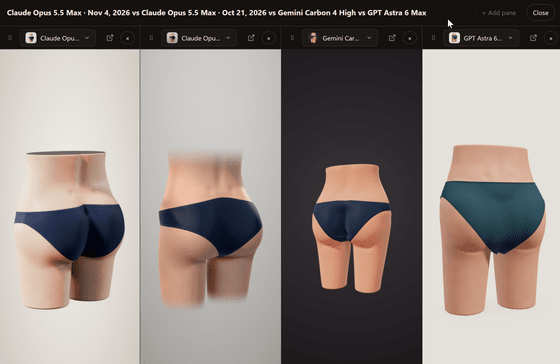
AssBench asks AI models to generate interactive 3D anatomy in a single HTML file. The project began as a joke, but its growing collection of model comparisons is raising a more interesting question about how well AI can actually write and execute code.
A new artificial intelligence benchmark has found an unusual way to compare the capabilities of leading language models: ask them to build a realistic, interactive 3D model of human buttocks.
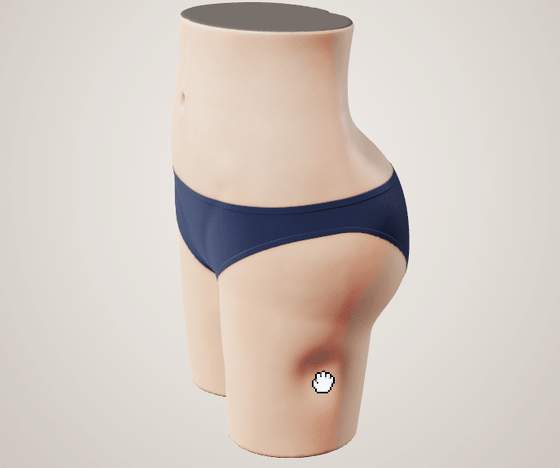
Called LLM AssBench, the project gives AI models the same programming task and compares the resulting graphics. The generated models can be rotated in a browser and clicked to trigger simulated soft-tissue movement.
The premise sounds like internet humour, and just some new meme material, but the engineering challenge is considerably more demanding.
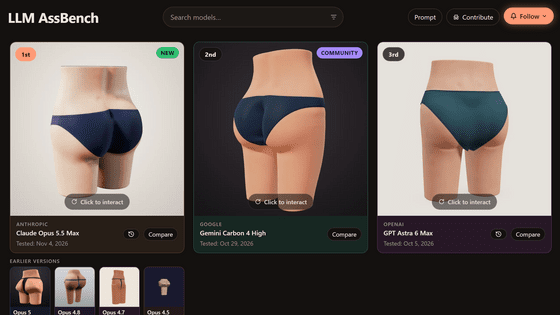
The benchmark is available at assbench.com, where visitors can inspect submissions from companies including Anthropic, OpenAI and Google. Its public collection includes 42 model runs, counting earlier versions, according to the website’s listing we retrieved on November 9, 2026.
One prompt, a surprisingly demanding assignment
AssBench was published by developer Luigi on September 24, 2026. In a blog post introducing the project, he described its central idea as “One prompt, Multiple models, Multiple dates.”
The instructions require each model to produce a single HTML file that works directly in Chrome. The file can use a pinned version of Three.js, a JavaScript library for 3D graphics, but cannot rely on downloaded images, textures, fonts or prebuilt 3D models. The geometry and materials must be generated programmatically.
The specification goes considerably further than producing a recognisable shape of human buttock. The model must construct a continuous lower-body figure extending from the waist to the thighs, with anatomically plausible proportions. It must generate and render convincingly from the front, sides and back, use realistic-looking skin materials, and support rotation through mouse or touch gestures and even have touch features too.
When you click on the model, you should see it react with a nice local deformation, almost like it’s squishing a bit. After that, it should bounce back gently, much like a spring. The developer aims for this interaction to run smoothly at 60 frames per second (60fps), all while making sure the entire scene fits comfortably within a 400-by-400-pixel space.
The prompt even permits models to inspect screenshots using Playwright, a browser automation tool, and revise their work. The stated development window is two hours, with an allowance of up to three.
That makes the test more involved than a conventional coding question. A model has to translate written instructions into geometry, implement the rendering pipeline, handle user input, and check whether the result actually works.
Luigi’s argument is that familiar academic tests can reward models for encountering similar questions in their training data. AssBench instead combines constraints that, according to the developer, cannot be satisfied by simply retrieving an existing finished example.
The leaderboard has a different story from the original claims
The public website does contain a ranked collection of submissions. Its November 9 listing places Anthropic’s Claude Opus 5.5 Max first, followed by OpenAI’s GPT Astra 6 Max and Google’s Gemini Argon 4 High. Claude Sonnet 5.5 Max occupies fourth place, while Claude Fable 5.1 Max is fifth.
The site records individual model versions and testing dates, allowing visitors to inspect earlier submissions.
There is an important detail behind the numbers: Luigi’s September introduction described a proposed 40-point scoring system covering realism, interactivity, physics and reliability. At the time of his October 1 update, those numerical scores were still unpopulated. The public ordering should therefore not be confused with a published, independently validated 40-point evaluation.
A real-world test reaches Linus Tech Tips Labs
The benchmark has also attracted attention beyond its creator’s website.
In an article published on November 2, 2026, LTT Labs documented its own experiments with AssBench while investigating locally hosted AI agents. The team tested models through different agent frameworks, comparing smaller models running on local hardware with cloud-based systems.
The results exposed some of the practical difficulties:
- Google’s Gemma 4 26B A4B failed to produce the expected 3D rendering after 15 minutes. Its output contained little more than a faint glow against a black background.
- Alibaba’s Qwen 3.8 27B, running through the Hermes Agent framework at medium reasoning, spent more than two hours producing a result. The researchers described it as recognisably on the right track, although the anatomy remained questionable.
- DeepSeek 4.1 Flash, running through the Pi agent framework on an Nvidia DGX Spark cluster, used most of its three-hour testing window. Its resulting model also fell short.
- OpenAI’s GPT-6 Astra performed better in the Labs team’s experiments. The researchers said the best results came from Astra running through Hermes and OpenAI’s Dots agent.
The models used different hardware, frameworks, and configurations.
The smaller-model surprise
One of the more interesting findings comes from Luigi’s own experiments.
He reported that Claude Haiku 4.5, a smaller Anthropic model, produced a clean result on its first attempt using default settings. That put it alongside submissions from substantially larger models that generally ran with maximum or ultra reasoning effort.
The current leaderboard lists Claude Haiku 5.5 in 13th place, with its earlier Haiku 4.5 submission available for comparison.
This is relevant because a model’s performance is often discussed in terms of its size, reasoning budget or position on established coding benchmarks. AssBench offers a different kind of comparison: whether a model can complete a specific, demanding visual programming task without extensive intervention.
The project’s next proposed development is a 40-point evaluation covering realism, interactivity, physics and reliability. Luigi has described this as a way to make comparisons more systematic, including for developers choosing between expensive frontier models and cheaper alternatives.
References:
Luigi’s original project announcement, September 24, 2026
LTT Labs’ November 2 testing report
