

A website dedicated to making paper airplanes fly farther and more predictably has become an unexpected hit among internet users, bringing a childhood pastime into the kind of searchable online database more commonly associated with technical hobbies.
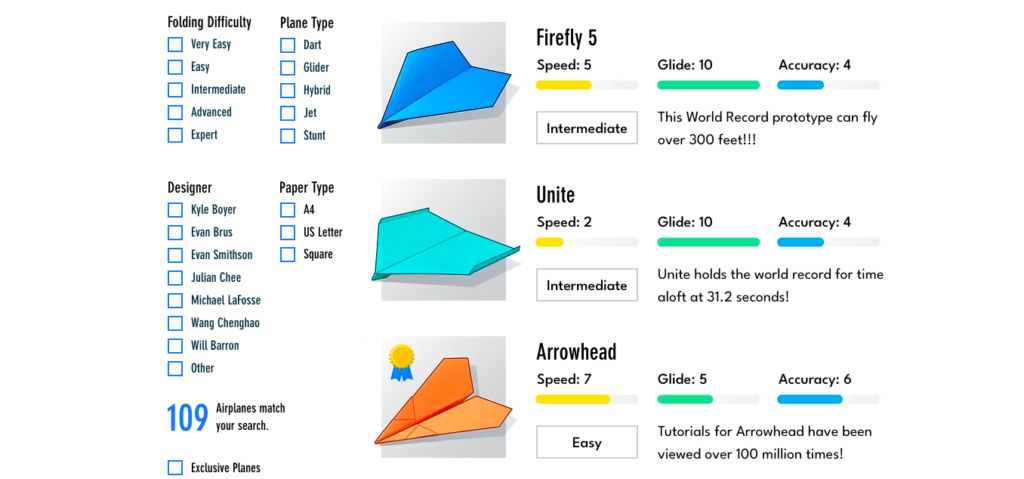
Called Foldable Flight, the website brings together more than 100 paper airplane designs, each accompanied by folding instructions, performance ratings and video tutorials. Visitors can browse models according to how difficult they are to make, what kind of flight they are designed for and which paper they require.
The recent attention gathered pace on November 9, 2026, when the website was shared on Hacker News. The post climbed into the site’s most popular submissions, attracting hundreds of points and comments. It subsequently received coverage from Boing Boing, Adafruit and Japanese technology publication GIGAZINE.
The site’s appeal is straightforward: instead of searching through individual videos to find a plane that suits a particular skill level, users can compare designs in one place.
Foldable Flight was created by Kyle Boyer, a graphic designer who says he has spent 18 years designing paper airplanes. On his website’s introduction page, Boyer describes the hobby as a combination of mathematics, engineering and art.
From a childhood hobby to a searchable aircraft library
The catalogue currently lists 109 designs. Its filters cover five difficulty levels, from Very Easy to Expert, and five aircraft categories: Dart, Glider, Hybrid, Jet and Stunt. Users can also narrow their selections by designer and paper size, including A4, US Letter and square paper.
Each design receives three separate scores, from one to 10:
- Speed: How fast the plane is designed to fly.
- Glide: Its ability to remain airborne.
- Accuracy: How consistently it can follow its intended flight path.
The ratings give users an idea of what to expect before attempting a fold. A Ballista, for example, receives 10 for speed but only two for glide. The Unite takes the opposite approach, scoring 10 for glide and two for speed.
The site also includes designs with documented performance records. Unite is listed as the holder of the world record for time aloft at 31.2 seconds. Another prototype, Firefly 5, is advertised as capable of flying more than 300 feet.
There are easier projects for beginners, too. Mystic, rated Very Easy, is described as a modified version of the Nakamura Lock, a design associated with Japanese paper airplane maker Eiji Nakamura. Its ratings are four for speed, eight for glide and four for accuracy.
Every listing connects to a video tutorial, allowing users to follow the folding process rather than relying exclusively on written instructions. The videos are published through Boyer’s Foldable Flight YouTube channel.
Boyer says some of his creations circle back towards the person who launches them, while others spiral, glide or travel long distances.
Most of his designs use ordinary 8.5-by-11-inch paper. He says he avoids cutting, glue and tape, treating the restrictions of a single sheet as part of the design challenge.
A viral discussion brings first-hand reactions
The Hacker News discussion offered more than traffic for the website. Readers began testing the designs and comparing them with paper airplanes they remembered making as children.
One commenter described following the Mystic tutorial with a sheet of A4 paper found at a desk. The user wrote that it was the best-performing paper airplane they had made, praising how smoothly it travelled in a straight line.
The same commenter subsequently attempted three other designs, including AeroDactyl, which has flapping wings, and the more difficult Elanus. The experience was mixed: Mystic and Jetstream worked well, while AeroDactyl failed to fly as demonstrated.
Other contributors recognised the Nakamura Lock immediately, with some recalling making versions of it in school or learning it from paper airplane books decades ago.
Now, when I am reading the same news story on November 11, the original submission had accumulated more than 1,200 points and 167 comments.
In a comment, he wrote that he had been designing paper airplanes since childhood and that the website also included work by other designers, including aircraft holding world records for distance and time aloft.
He invited readers to offer feedback, saying he hoped to improve existing features and introduce additional ones.
The website now lists 109 designs, with the Mystic, Unite, Firefly 5 and Arrowhead among its featured aircraft. boingboing.net+3
