

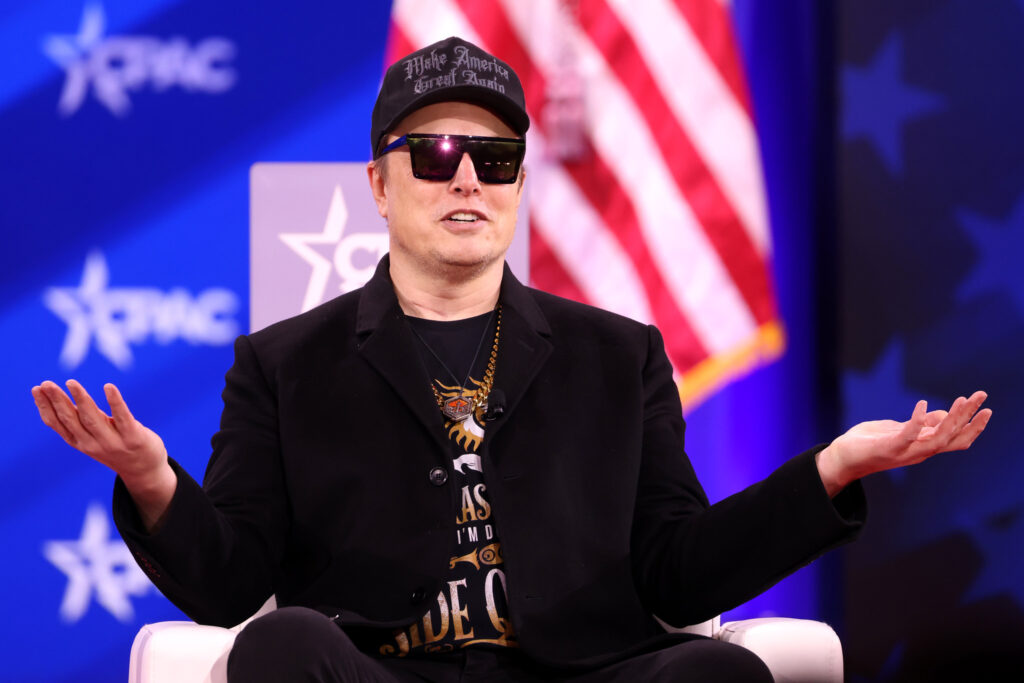
The New York Times’ November 1 ranking shows Musk far ahead of other political donors, with the top 20 individuals, companies and organisations contributing a combined $1.945 billion to federal election contests.
Elon Musk has emerged as the biggest donor of the 2026 US midterm election cycle, contributing approximately $445.6 million to Republican-aligned political groups, according to an updated analysis published by The New York Times on November 1.
The ranking, compiled by reporters Matt Zdun and Theodore Schleifer, puts the combined contributions of the 20 biggest donors at approximately $2 billion through the latest federal filing deadline in mid-October.
Elon Musk (the richest person in the world) alone accounts for nearly 23% of the total.
The 20 biggest donors of the 2026 midterm elections
The following ranking is based on the figures published in the New York Times analysis.
| Ranking | Donor Name | Contributions in USD |
|---|---|---|
| 1 | Elon Musk | $445.6 million |
| 2 | Dick and Liz Uihlein | $150 million |
| 3 | One Nation | $138 million |
| 4 | Marc Andreessen and Ben Horowitz | $116 million |
| 5 | Jeff Yass | $110 million |
| 6 | Majority Forward | $104 million |
| 7 | George and Alex Soros | $103 million |
| 8 | House Majority Forward | $97 million |
| 9 | Mike Bloomberg | $85 million |
| 10 | Ripple Labs and Chris Larsen | $73 million |
| 11 | Miriam Adelson | $68 million |
| 12 | American Action Network | $64 million |
| 13 | Coinbase | $55 million |
| 14 | Paul Singer | $54 million |
| 15 | Cameron and Tyler Winklevoss | $53 million |
| 16 | Greg and Anna Brockman | $50 million |
| 17 | American Prosperity Alliance | $48 million |
| 18 | Koch Inc. | $47 million |
| 19 | Reid Hoffman | $42 million |
| 20 | Economic Opportunity Fund | $42 million |
NOTE: Figures are rounded here, and the total calculated from the displayed amounts is approximately $1.945 billion.
I collected the data from the official New York Times list of the biggest midterm donors:
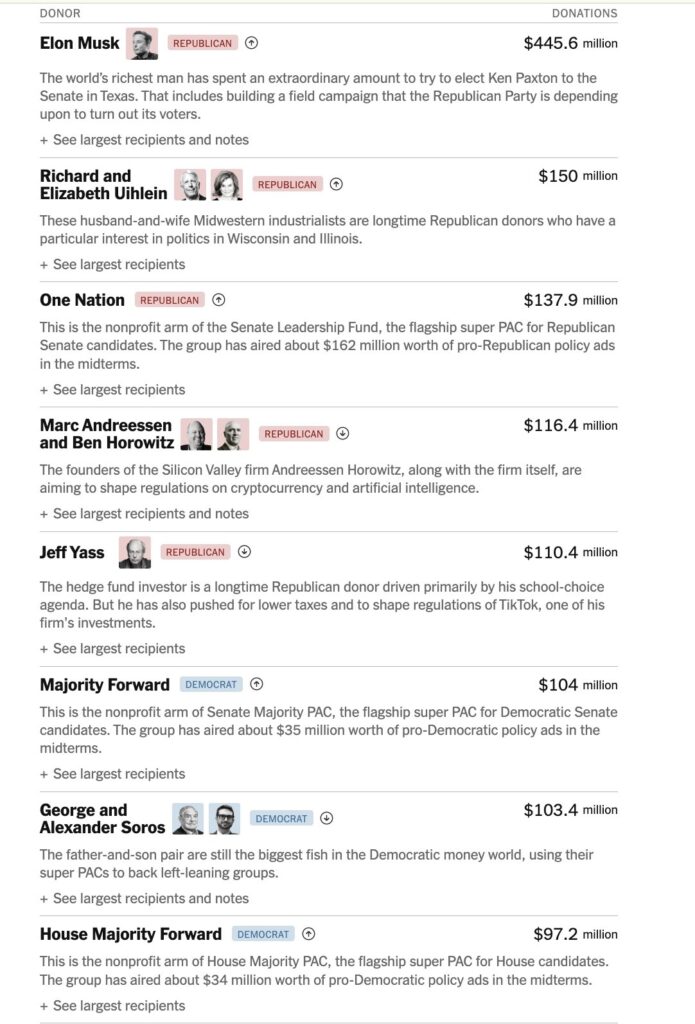
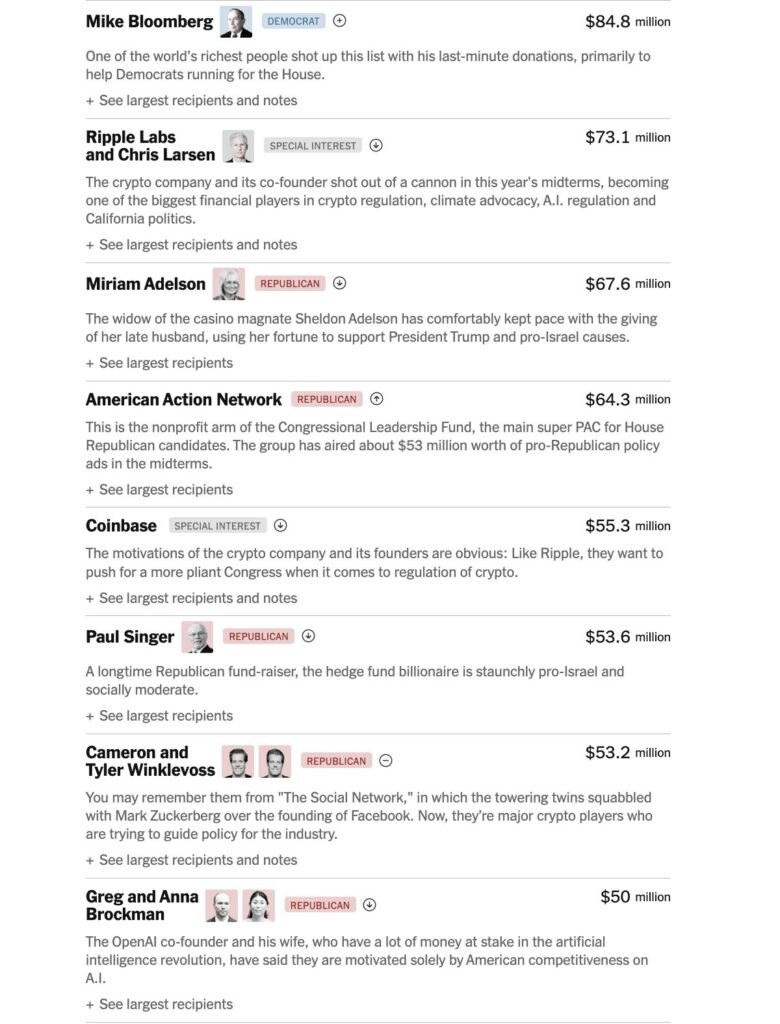
Musk’s contribution is almost three times the second-place entry
The gap between Musk and the rest of the ranking is substantial. Richard and Elizabeth Uihlein, the owners of Uline, occupy second place with $150 million in contributions.
Musk’s $445.6 million is almost three times their combined amount.
His political spending has also attracted attention because of its concentration in Republican election efforts. The Associated Press, reporting on federal filings, previously detailed more than $276 million in contributions from Musk since July. Those included $158 million for the Senate Leadership Fund, $76 million for America PAC and $10 million for Lone Star Liberty PAC, which supports Texas Republican Senate candidate Ken Paxton. These contributions form part of the wider election-cycle picture, rather than additional amounts to be added to the overall figure.
Technology and cryptocurrency interests also feature prominently in the ranking. Andreessen and Horowitz account for $116 million, while Ripple Labs and Chris Larsen contribute $73 million. Coinbase appears with $55 million, and the Winklevoss brothers with $53 million.
Their presence reflects the growing role of technology and cryptocurrency money in federal elections, where political spending can also affect debates over regulation and government oversight.
Political organisations account for a significant share
The ranking includes political organisations as well as wealthy individuals and private companies.
One Nation, with $138 million, ranks third. Majority Forward and House Majority Forward contribute another $201 million combined. American Action Network, American Prosperity Alliance and Economic Opportunity Fund also appear among the top 20.
Some organisations operating in this space do not disclose the original sources of all their funding.
A separate analysis published by the Brennan Center for Justice on October 27 found that the 40 biggest donors had contributed more than $2.4 billion through mid-October. Its researchers estimated that Republican-aligned donors gave more than three times as much as donors consistently supporting Democrats.
They also found that dark-money organisations accounted for 29% of contributions by the top 40. The Brennan Center uses a different methodology and a larger donor group than the New York Times ranking.
How donors can contribute hundreds of millions
The sums are possible largely because much of the money moves through political action committees rather than directly into candidates’ campaign accounts.
Under US election rules, super PACs can accept unlimited contributions from individuals, corporations, labour organisations and other political committees. They can use that money for independent political spending, including advertisements supporting or opposing candidates, but cannot coordinate that spending with the campaigns themselves, according to the Federal Election Commission.
Public Citizen, which separately examined federal election filings, reported on October 27 that 515 individuals and organisations had each contributed at least $1 million to super PACs during the 2026 cycle.
Their contributions totalled $4.2 billion, representing 73% of the money raised by those committees from the sources covered by its analysis. Musk alone accounted for approximately 10%.
