

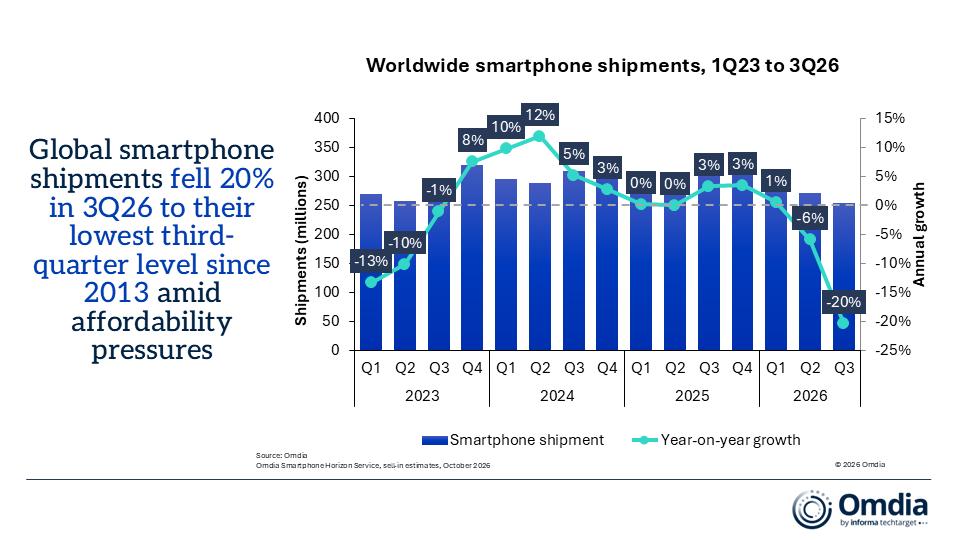
Global smartphone shipments fell 20% year on year to 254.7 million units in the third quarter of 2026, the lowest third-quarter total since 2013, according to Omdia.
The decline accelerated from a 6% drop in the previous quarter, as memory and storage costs constrained pricing flexibility and prompted vendors to scale back shipments of low-margin devices.
- Samsung retained the top position with 57.8 million units shipped, down 5% year on year, and a 23% market share, up from 19%.
- Apple shipped 56.5 million iPhones, flat on the year, and held 22% of the market, up from 18%.
The two vendors together accounted for 45% of global shipments, an increase of about 8 percentage points from a year earlier, according to Omdia.
Xiaomi remained third with 30.7 million units, down 29%, as shipments fell 20% in China and 28% in India.
OPPO, including realme and OnePlus, shipped 23.4 million units, down 39%. vivo shipped 19.3 million units, down 33%.
Counterpoint Research, which also pegged the global decline at 20%, said Xiaomi’s share fell to 10% as the company cut exposure to lower-priced devices and some overseas markets to protect margins.
“Emerging markets, once the backbone of global smartphone volume growth, are now facing the greatest pressure from rising prices,” said Sanyam Chaurasia, principal analyst at Omdia.
Africa recorded the steepest contraction at 39% year on year. APAC excluding Greater China, the Middle East and Latin America also declined by more than 20%.
Omdia expects global smartphone shipments to decline by 12% in 2026.
“Beyond rising component costs, vendors face growing inventory risks as they balance existing stock with new product generations,” said Amber Liu, practice leader at Omdia.
The market is expected to decline further in 2027, with persistent high-bandwidth memory shortages keeping costs elevated.
IDC reported a 22% decline to 255.3 million units for the quarter, which it described as the largest quarterly drop on record.
Counterpoint said the outlook for the remainder of 2026 remains challenging, with production cuts and tighter portfolios likely to continue.
Maybe the upcoming wave of smartglasses is already making a dent in smartphones’ demand?
