

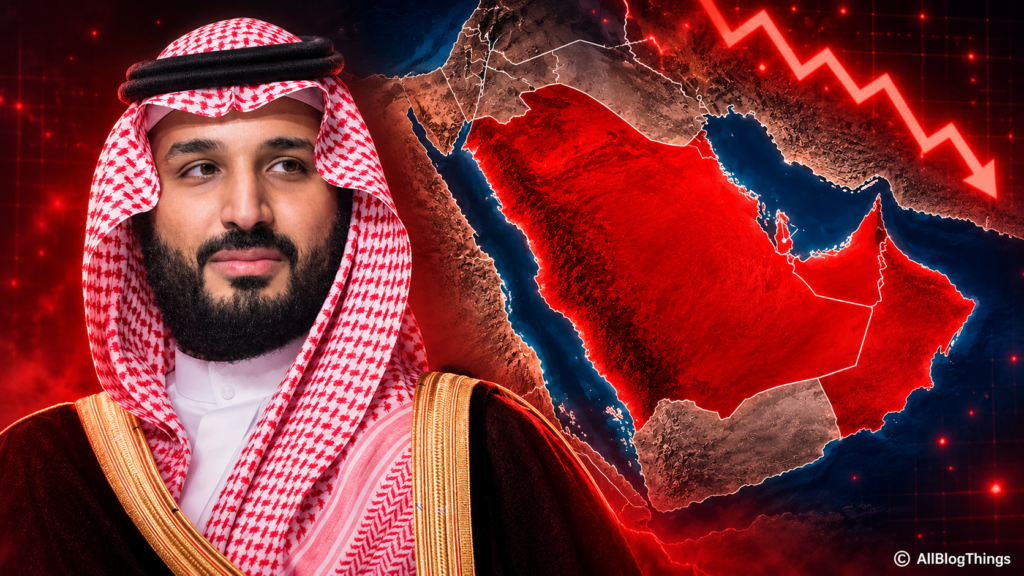
Allianz Research put the bill at $990 billion in a report published on November 9, 2026. The figure covers the six members of the Gulf Cooperation Council: Saudi Arabia, the United Arab Emirates, Qatar, Kuwait, Bahrain and Oman.
It combines $790 billion in lost output from 2026 to 2030 with physical damage of just above $200 billion.
The report was written by Ludovic Subran of Allianz Investment Management and Lluis Dalmau, Ana Boata and Maria Latorre of Allianz Trade, with Dorian Simon of Allianz Investment Management.
The $790 billion is the gap between what those economies were set to produce on their pre-war trend from 2026 to 2030 and what Allianz now expects them to produce.
“The total cost of the war for the GCC is set to reach $790bn, a cumulative gap of 5.9% of GDP relative to the pre-war trend through 2030,” the report said.
The $990 billion total adds the physical damage to that gap.
The report sat for 10 days before it moved markets and newsrooms. Allianz built them on an assumption of no major new escalation, an assumption already under strain in the Strait of Hormuz.
Allianz expects GCC gross domestic product to contract by 4.0% in 2026, which is 8.2 percentage points below pre-war forecasts.
The International Monetary Fund is gloomier, forecasting a 4.8% contraction for the region, bne IntelliNews reported via TradingView.
Qatar is forecast to shrink by 14%, Kuwait by around 11% and Bahrain by 8%, because each sits behind the Strait with no full way around it.
Saudi Arabia is forecast to contract by 2.8% and the United Arab Emirates by 0.9%, because each can route part of its exports around the strait through pipelines and Red Sea ports.
Oman is the outlier, with growth of 3.3%, because it has a full bypass and has acted as a bridge to world markets.
More than 80 energy sites hit
Damage of just above $200 billion is concentrated in energy infrastructure in the economies locked behind the strait. More than 80 energy facilities, from production plants to refineries and pipelines, have been hit, a third of them severely, Allianz said.
Most oil and gas production infrastructure escaped major damage, so Allianz expects the hydrocarbon shock to be temporary. The exception is Qatar. A gas field producing about 18% of its output, around 4% of world liquefied natural gas, was severely damaged in the first weeks of the war and will take several years to return to normal, deepening the shock at Ras Laffan.
A new era of borrowing
Allianz calls the shock primarily fiscal. It expects a cumulative budget deficit of $475 billion across the six states from 2026 to 2030. Counting $247 billion of debt that comes due, gross financing needs reach $722 billion.
Allianz expects $534 billion of debt issuance, including $301 billion of new borrowing on top of rollovers, plus $125 billion drawn from foreign exchange reserves and, “as a last resort,” $90 billion of transfers from sovereign wealth funds. The report describes the turn as “a new era of borrowing” for a region that has spent five decades recycling oil surpluses into global bonds.
Bahrain is the most exposed. With a fiscal break-even oil price of $161 a barrel and central government debt at 134% of GDP, it is left with an uncovered gap of about $6 billion, “pointing to a new support program coming for the island state, as in past episodes,” the report said.
By early October, credit default swap spreads were up 80% since the start of the year in Bahrain, 58% in Qatar, 32% in Dubai and 26% in Kuwait. Portfolio inflows fell 48% in Saudi Arabia from March to August 2026 compared with the same period of 2025.
Regional inflation is projected to more than double this year to 2.6%, with Qatar at 4.5%, the UAE at 4.5% and Oman at 3.9%. The hydrocarbon economy is set to contract by 8.5% year on year and trade by 5.5% year on year.
The external cushion thins but holds, Allianz wrote. The current account surplus is set to halve from an annual average of $200 billion in 2021 to 2025 to $100 billion.
Foreign direct investment is set to run about $136 billion, or 16%, short of its pre-war path.
Gulf sovereign wealth funds, with $4.7 trillion of assets, are expected to bring home around $120 billion for domestic investment through 2030, more than the $74 billion the five largest funds withdrew during the Covid-19 pandemic, according to Global SWF figures cited in the report.
The Qatar Investment Authority has already slowed its pace by around $2 billion a quarter since March. Allianz wrote that the shift “means less Gulf demand for global fixed income over time.”
From The Line to bypass routes
The war speeds up a retreat from the mega-projects of the Vision programmes that predates it, Allianz said.
Saudi Arabia has cut as much as $300 billion of committed and planned investment from The Line at NEOM, while keeping priority for the 2034 FIFA World Cup. Allianz expects $380 billion to $400 billion of new commitments to trade, transport, power grids, water, defence and data centres, including about $160 billion of openings for foreign investors in routes that bypass Hormuz and in defence.
Investment is shifting from the Gulf coast toward the Red Sea, and the UAE has said it will be fully off Hormuz by late 2027.
Tourism and property take the visible hit
Tourist arrivals fell 22% year on year in the first half of 2026. The region’s tourism receipts are on course for about $104 billion this year, $56 billion short of a war-free 2026. Dubai home prices were 10.2% below their January peak by September.
“The real economy has been recovering, but the Houthi strikes on the Riyadh airport were a stark reminder that the rebound is still at risk from events on the ground,” the report said.
The October attack on Riyadh airport wiped out third-quarter gains in tourism and pushed a return to near pre-war levels back to 2029, according to Allianz.
How the war reached the Gulf
Allianz calls the conflict the U.S.-Iran war. Since it began on February 28, Iran has fired more than 7,000 missiles and drones at Gulf states, which now demand that Tehran pay compensation, bne IntelliNews reported.
Iran also closed the Strait of Hormuz, which blocked almost all exports routed through it, Allianz said.
Oil flows have since returned to pre-war levels for part of September, but about 20 commercial ships have been attacked there in the past month.
The bill will show up in bond markets before it shows up in rebuilt plants. Heavier issuance means spreads are set to widen unevenly through 2030, Allianz said, with Bahrain facing the largest repricing at more than 100 basis points, while highly rated sovereigns see limited issuance-driven widening, leaving geopolitical risk as the main driver of their spreads.
For anyone who holds Gulf bonds, works on a Gulf project, or pays rent or a mortgage in Dubai, that repricing, plus slower growth and higher inflation, is the channel through which a $990 billion forecast becomes a monthly cost.
Allianz built its numbers on no major new escalation. This week Iran claimed two oil tankers hit naval mines in the strait, a reminder of how fragile that assumption is.
