


It looks like a normal manual toothbrush. Same handle, same head. The difference is what the bristles are made of.
Researchers at Peking University School and Hospital of Stomatology swapped nylon for polyvinylidene fluoride, PVDF. It is the same polymer that shows up in wire insulation and battery separators. Stretch it and heat it a certain way and it turns piezoelectric. Squeeze it, bend it, and it throws off a tiny electric charge directly into your mouth on your teeth.
The team built bristles out of it. When you brush, the bristles flex and release that charge into saliva. That charge kicks off reactive oxygen species, very short lived molecules that chew up bacterial membranes. When the bristle straightens, it pulls the charge back in. No motor, no charger, no battery.
It sounds like a magic trick to me!
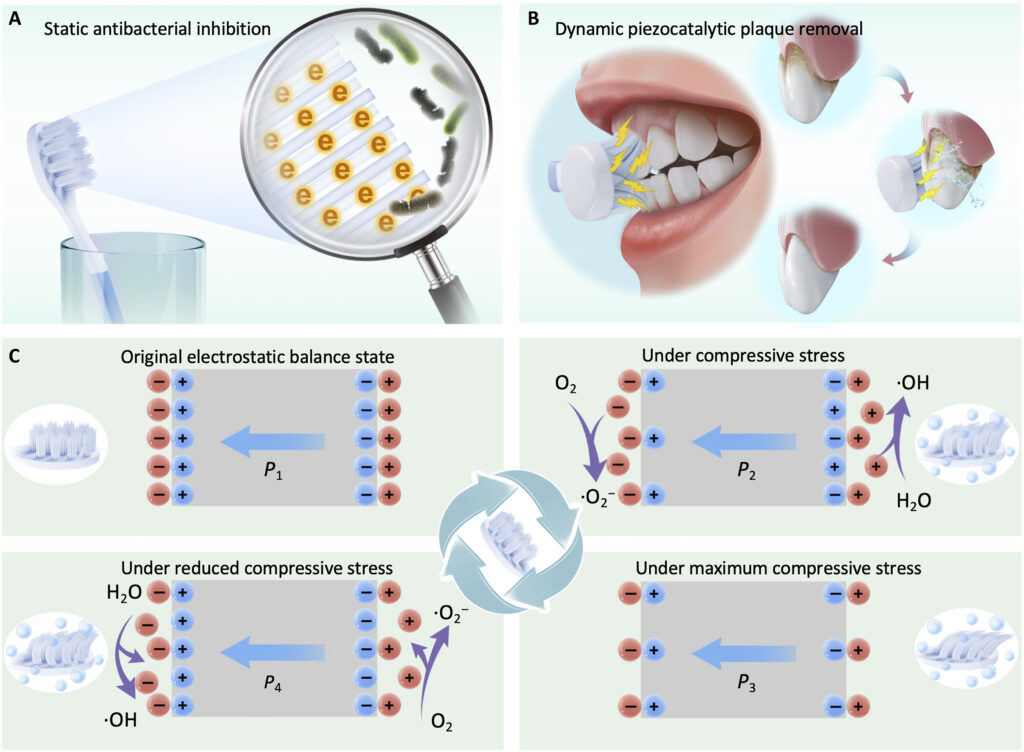
The paper went up Nov. 4 in Science Advances: “Self-charged toothbrush facilitates tooth healthcare maintenance,” DOI 10.1126/sciadv.aeg5744.
First authors are Yanhui Lu, Jia Song and Xiaopei Chi. Corresponding authors are Xuehui Zhang and Xuliang Deng at the university’s Dental Materials Laboratory.
Lab numbers help explain why they bothered. In a filing related to the work, the bristles produced about 0.6 to 1.5 volts under brushing force.
On simulated teeth (fake teeth), PVDF killed about 52.8% of Streptococcus mutans, the bacterium most associated with cavities, and 78.21% of Porphyromonas gingivalis, associated with gum disease. Nylon in the same setup killed 9.29% and 8.41%.
The gap held for plaque itself.
Human plaque grown on bovine enamel and brushed for three minutes came off at over 99% with PVDF and about 80% with nylon.
The lab runs used long contact, so that is not what a two minute morning brush does, but it shows the chemistry is there.
Then they tried mouths (like mouths of real people).
Dentists at Peking University Hospital of Stomatology screened 135 adults with plaque and inflamed gums and enrolled 115.
Four groups, two thicknesses of PVDF and two regular nylon manuals.
Same instructions for everyone, and everyone used fluoride-free toothpaste so fluoride would not mask the effect.
Twice a day for three months.
They have complete results for 109 people, 30 and 25 in the PVDF groups and 28 and 26 in the nylon groups.
Plaque scores fell by about 40% with the self-charging brush, compared with about 15% with nylon.
Bleeding and inflammation fell with it. When they sequenced the plaque, disease linked bacteria were down and the balance tipped toward beneficial species.
In lab checks the material did not roughen enamel and did not poison human cells.
Even the volunteers reported no pain, no numbness, no shocks.
Zhang Xuehui, corresponding author and director of the Dental Materials Laboratory at Peking University School and Hospital of Stomatology, said the new toothbrushes “combine physical cleaning with sustained antibacterial effect, thus highlighting the potential of self-charged materials in advancing oral healthcare.”

Outside dentists who were not part of the work are interested but cautious.
Generating electricity from brushing is a “new twist on an old concept,” Frank Scannapieco, a periodontist and microbiologist at the University at Buffalo, told Nature.
Nicholas Jakubovics, a professor at Newcastle University’s School of Dental Sciences, called it “a really innovative approach, essentially because mechanical force is recharging the surface,” adding that “because oral diseases are so widespread, anything that improves oral care even slightly can be a benefit.”
He said large-scale studies are now needed to confirm whether the piezoelectric toothbrush actually prevents problems such as cavities and tooth loss.
The work was funded by the National Natural Science Foundation of China and other national and provincial programs. The authors listed no competing interests. No product is on sale yet.
