

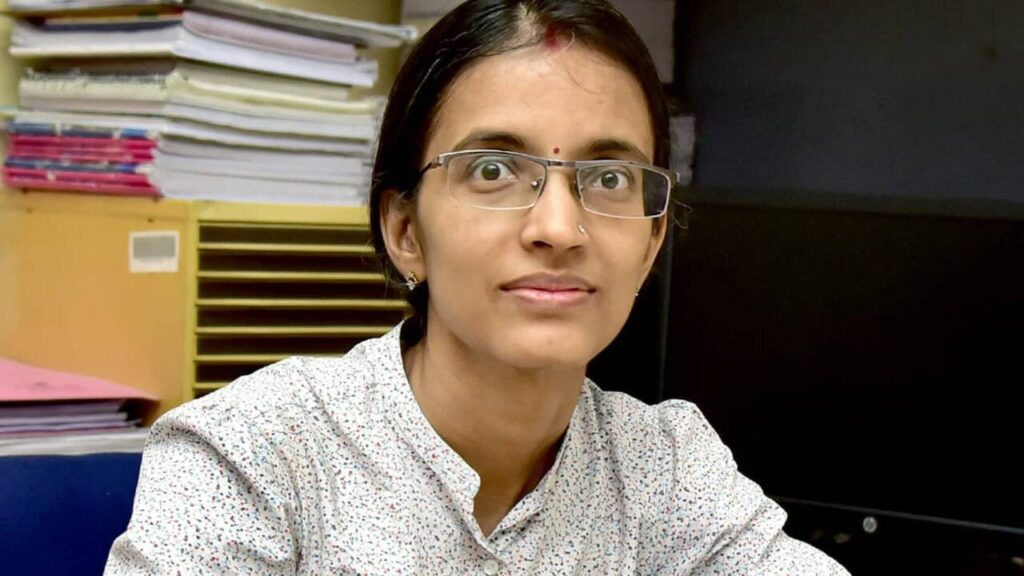
On November 19, 2026, TIME announced its inaugural TIME100 Next India list of 100 emerging leaders. Neena Gupta, a professor in the Theoretical Statistics and Mathematics Unit at the Indian Statistical Institute (ISI) in Kolkata, was named in the Health and Science Innovators category.
Within two days, Instagram and Facebook posts carried the same line: Kolkata mathematician Neena Gupta solves a maths problem that remained unanswered for 70 years. However, the proof was actually published in 2014.
Gupta did the work as a doctoral student and young researcher in Kolkata 12 years ago and TIME put her back in public view because the famous list covers emerging leaders across science, business, arts and advocacy.
What she proved
Oscar Zariski, a founder of modern algebraic geometry who posed a version of the problem in 1949.
In Gupta’s own words:
“The cancellation problem asks that if you have cylinders over two geometric structures, and that have similar forms, can one conclude that the original base structures have similar forms?”
The Infosys Prize jury put it in plainer form by writing that the problem asks if two geometric objects have the same structure after adding a dimension to them, can one deduce that they are in fact the same. In her breakthrough work, the jury wrote, she showed that, in positive characteristic, contrary to what one might expect, the answer is in the negative.
Gupta did it with a counterexample, not with a proof that the answer is always yes or always no.
Back in 2014 she proved that a 3-dimensional affine variety constructed by Asanuma yields a negative answer to the Zariski Cancellation Problem in positive characteristic. Her paper was titled On the Cancellation Problem for the Affine Space A^3 in characteristic p. It showed that the Cancellation Conjecture does not hold for the affine space A^3 over any field of positive characteristic.
In geometric terms, the Infosys Prize said, adding a dimension is like considering cylinders over the objects. Gupta showed that the cylinders can match while the original objects do not.
The jury wrote:
“Thus, the innocuous looking move of adding a dimension can destroy information.”
The paper was received on September 5, 2012, accepted on January 18, 2013, and published online on February 6, 2013. It appeared in Inventiones Mathematicae in 2014, volume 195, pages 279 to 288.
How the proof came together
Prof. Dr. Neena Gupta was born in Kolkata in 1984. She studied at Khalsa High School, Dunlop, graduated with honours in mathematics from Bethune College in 2006, completed her M.Math. at ISI Kolkata in 2008, and earned her Ph.D. at ISI Kolkata in 2012 under Professor Amartya Kumar Dutta.
Her mother, Gyanlata Gupta, encouraged her and her brother to solve problems, often turning practice into friendly competition. Gupta later said she was the only woman in her postgraduate mathematics class at ISI.
Circa 2009, Gupta, then a PhD student at ISI Kolkata, approached a professor in whose paper she had come across the Zariski Cancellation Problem. Gupta had ideas about how to crack it, but the professor advised her to drop it and not waste her time. While Gupta stopped actively pursuing it, it was a problem that was always haunting her, at the back of her mind, ThePrint wrote.
In 2011, she explained some ideas to Professor Teruo Asanuma, who was visiting ISI. Gupta recalled his reply in an interview with TWAS: “Neena, this is really very difficult.” He was apprehensive that attempting such a problem would lead her nowhere, TWAS wrote.
Her eureka moment came in 2012, when she found a workable solution. Mentors Professor S.M. Bhatwadekar and Professor Amartya K. Dutta checked the details and helped her organise the work into a paper, TWAS wrote.
She recalled the reaction after that: most experts could not believe that a then-unknown young scientist had solved such a problem, TWAS wrote.
Gupta told ThePrint:
“My colleagues have always been supportive of me, and even as one of the few women in the field, I have not faced any discrimination. But I think they didn’t have confidence in me. None of them thought I could make it.”
She also told ThePrint what she wants girls to hear:
“It’s not true that girls are naturally bad at maths. There’s a phobia ingrained in their minds, and lack of encouragement, which leads to unclear concepts that prevent girls from excelling in the field. Maths is a very logical subject, nothing to be afraid of.”
What came after the proof
The Indian National Science Academy gave her its Young Scientist Award in 2014 and described her solution as one of the best works in algebraic geometry in recent years done anywhere, ICTP wrote.
In 2019, she became the youngest mathematician ever to be awarded India’s Shanti Swarup Bhatnagar Prize, the country’s highest scientific honour, according to the Indian National Science Academy. In 2021, she received the DST-ICTP-IMU Ramanujan Prize for Young Mathematicians from Developing Countries for her work in affine algebraic geometry and commutative algebra, in particular for her solution of the Zariski cancellation problem for affine spaces. The prize committee said her work shows impressive algebraic skill and inventiveness. She was the third woman to receive that prize.
In 2022, the President of India conferred on her the Nari Shakti Puraskar. She was an invited speaker at the International Congress of Mathematicians in 2022. In 2023, she received the TWAS-CAS Young Scientist Award for Frontier Science. She told TWAS: “This award strongly motivates me to cultivate further my passion for investigating unresolved fundamental mathematical problems. The TWAS-CAS award is one of the great achievements of my life.”
In 2024, she won the Infosys Prize in Mathematical Sciences for her work on the Zariski Cancellation Problem. In 2025, she delivered the 44th Emmy Noether Lecture, titled The Abhyankar-Sathaye Conjecture for Linear Hyperplanes.
Why the 70 years line is shorthand
Zariski posed the problem in 1949. Gupta published the solution in 2014. From 1949 to 2014 is 65 years. The 70 years figure in viral social media posts and some news coverage counts roughly to the later prizes, or rounds the gap. It does not change the proof, but it does change the date. The proof was not new or given in November 2026. The TIME listing was too late to name this gem.
Gupta has not stopped with that one problem at all. She told ThePrint:
“There are many more problems surrounding the Zariski challenge. I am working to solve them too. Although I don’t know if and when I’ll be able to do it, I have to devise a method to crack it.”
